From the archive
What Museum Specimens Reveal About Madagascar’s Shrinking Flying Foxes
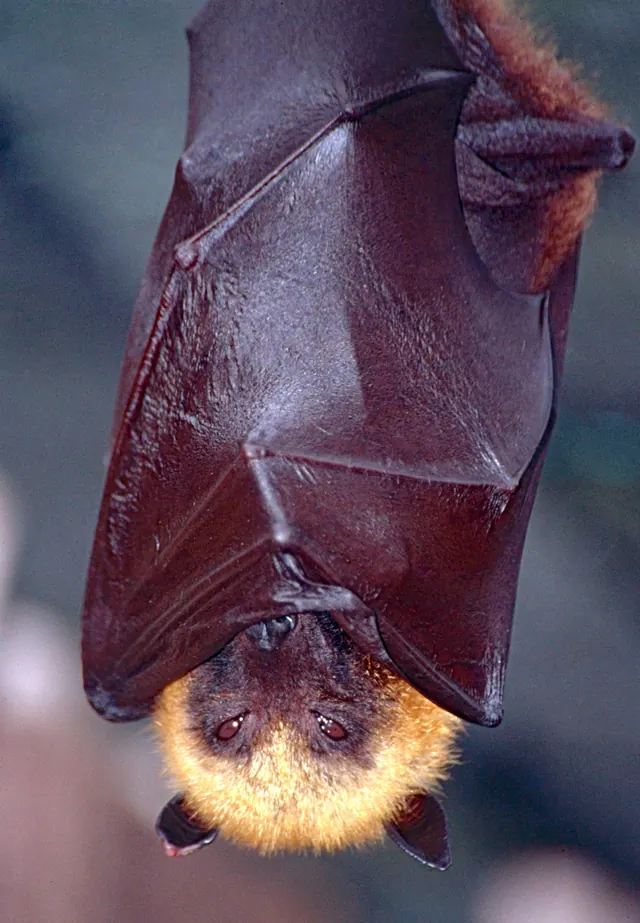
A museum drawer can hold a flying fox collected more than a century ago. Put that bat beside one collected decades later and the question becomes something you can measure. In the Journal of Mammalogy, Field Museum researchers Emily Cornelius Ruhs and Steven M. Goodman report that several adult skull measurements in Madagascar’s flying foxes declined after commercial hunting expanded. The teeth showed a less uniform change.
The bat at the center of the study is the Madagascar flying fox, Pteropus rufus. As it feeds on fruit, it helps disperse seeds. The Field Museum researchers noticed that older flying fox skins and skulls in their collections seemed bigger than bats of the same species they had encountered in Madagascar. That impression gave them a question they could take to the collections: would the difference still be there if they compared measurements over time?
Goodman went through 121 specimens at nine natural history museums in the United States and Europe. He measured skulls and teeth, and Ruhs analyzed how those measurements changed over time. The museum specimens span more than 150 years. Ruhs points to specimens collected in the 1800s as examples of how long a museum can keep an animal available for study.
What the skulls and teeth showed
Start with the age of the bat. In the study, older individuals tended to have larger measurements. A comparison that put young bats from one era beside older bats from another could make the earlier or later group look bigger simply because of its age. The researchers looked at adults and also examined whether the broader changes persisted after accounting for age structure. They did.
Across several measurements, adult skulls from the period after commercial hunting expanded were smaller. Think of that as a shift across a set of skulls, rather than a change that you could trace through one bat’s life. The specimens come from different animals. The comparison asks whether the collection of adults in one period looks different from the collection in another.
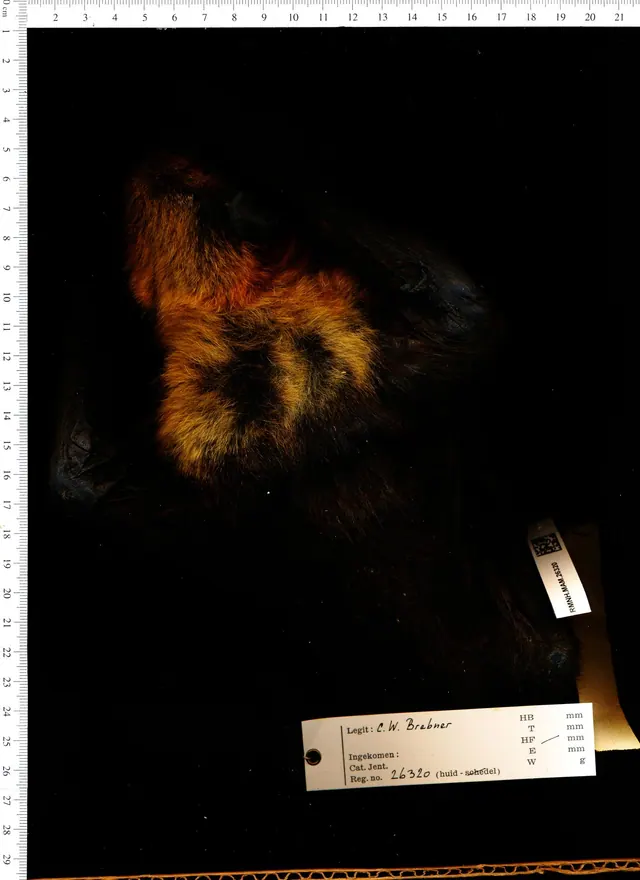
The results for teeth went in more than one direction. Most of the dental measurements decreased, and one increased. That gives the study two patterns to explain: a broad decline across several parts of the skull, and a less consistent change in the teeth. If you are looking at a photograph of a preserved flying fox, the head and the teeth belong to one animal, but each measurement follows its own history across the collections.
The decline in adult skull size was concentrated near the middle of the size distribution. The middle here is the median: line up the measured adults by size and look halfway along the line. A shift there is a change in what a middle-sized specimen looks like. It is different from finding one exceptionally small skull in a drawer and treating that animal as typical.
A drop around 1980
Ruhs told the Field Museum that she saw a clear drop beginning around 1980. In the study, she and Goodman place the expansion of commercial hunting between the 1980s and the mid-1990s. Put those events on a timeline and they sit close enough together to raise the question the researchers wanted to answer. The specimens let the team follow the change across decades on both sides of that point.
Goodman’s nine museum visits gave Ruhs a long series to compare. One collection can hold old and recent material in the same room, but the dates tell you which animals belong together in the comparison. Line up enough dates and measurements and you have a way to ask whether a change was gradual or clustered around a point on the timeline.
Why the researchers suspect hunting
Ruhs suspects that commercial hunting contributed to the change. In the Field Museum’s account, Ruhs suggests a larger flying fox might be easier to spot and offer more meat. Many of the largest bats in the museum study were also older. Those observations give the hunting hypothesis a specific form: if hunters disproportionately take large adults, the size distribution can change.
Ruhs also points to deforestation, shifts in the fruiting season and climate as possible influences. Those possibilities come from a different part of the bat’s life than hunting does. A biologist looking at the timeline has more than one idea to test. That is why it helps to begin with the measurements themselves: dates and dimensions give everyone the same result to account for.
The skull measurements show when size changed; they cannot establish why it changed or tell us how many flying foxes remain.
What the museum drawers make possible
The authors discuss continuing hunting, habitat loss and the species’ low reproductive output. They call for monitoring and a formal assessment of population viability. A fresh series of observations would give future researchers another point of comparison, much as Goodman’s measurements give the museum specimens new value today.
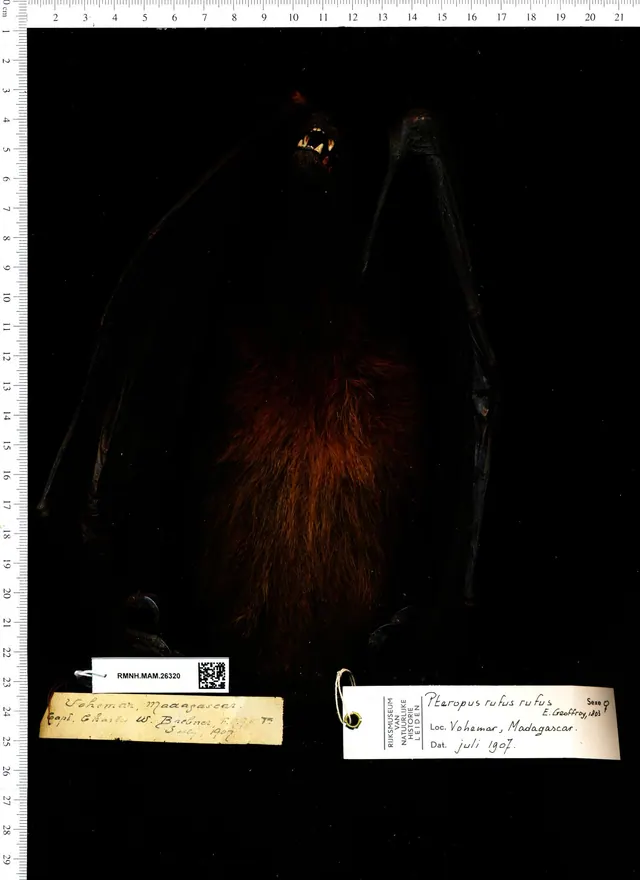
There is something satisfying about tracing that chain backward. Before the comparisons, there was a single bat with a place, a date and a label. Each label fixes one point in the timeline. With enough specimens, a detail that looked ordinary to the person writing it down can help two researchers notice a change more than a century later.
Try reading a museum label the next time a specimen makes you stop. Find where it was collected and when, then imagine placing another specimen of the same species beside it. Which feature would you measure on both? What would you compare if you had a row of specimens rather than two? That is the step that turns the Field Museum researchers’ first impression into a question other people can understand. Look at the different dates on the labels before you compare the animals. They are the first pieces of a timeline.
For the flying foxes, the most revealing answer came from adult skulls measured across that long span. The teeth keep the story from becoming a single number. An animal can change in ways that are clear in one measurement and less so in another, and the museum drawers give us a way to see both changes together.