
From the archive
How to Spot a Highland Calf in a Photo, and What a Photo Can't Prove
Prefer Family & Pets on GoogleSee more of our stories in your results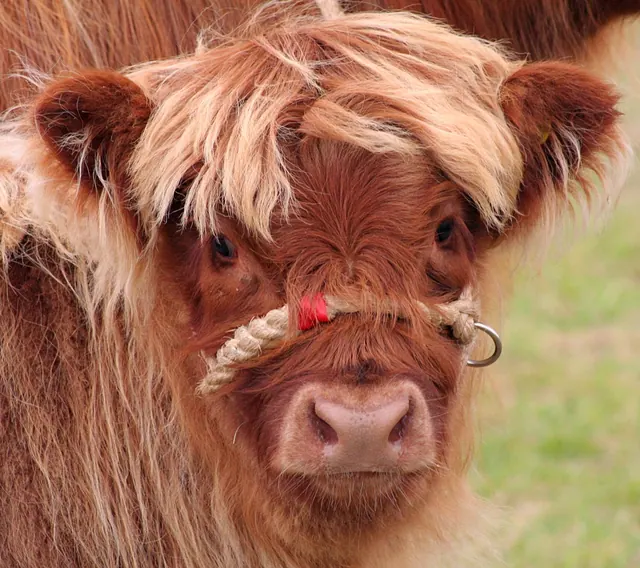
What does a photo of a fluffy Highland calf actually tell you? Start with what you can see. The Highland Cattle Society describes the breed’s long coat, the sweeping horns you see on adults, and the range of coat colors. Those are useful clues when you compare a few labeled photographs. A close-up can give you a good look at the hair over the eyes. A side view shows more of the coat and how it changes the outline of the animal.
Then ask what the caption is claiming. ‘Looks like a Highland’ is an observation about the calf in the picture. ‘Registered Highland’ refers to a record. A caption that says ‘miniature’ makes a claim about size, and you need measurements with some context before you can judge it. It’s easy to read all three claims in the same glance at a photo. They each require different information.
A good look doesn’t require getting any closer to a real calf. Compare photographs, or stay in a designated viewing area and follow the farm’s posted instructions.
What the breed society describes
Look at the hair on the head first. The society’s breed standard describes a long, bushy forelock, the hair between the eyes, and a coat with long, wavy hair. In a picture, that forelock can be what gives the calf such a different face from one with a short, smooth coat. Step back to take in the whole photograph and you may notice the hair along the neck and body as well. A view that shows both is more useful than a tight crop of the face.
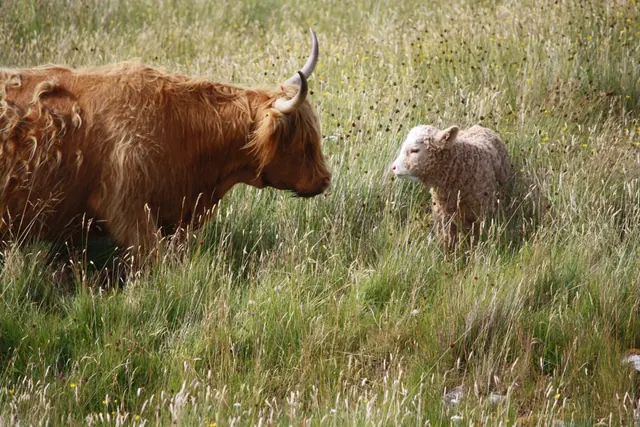
The Highland Cattle Society's breed description names red, yellow, brindle, dun, white and black. Red is the color many people picture first. A black calf or a pale one can fit the breed description too. The contrast is easy to see when you look at a red calf and the black cow and calf pictured here. The shades are different, and you can still compare how the long hair lies around the face and along the body.
The breed society dates its first published Herd Book to 1885. A herd book gives people a place to record an animal’s ancestry. That matters when a photograph comes with a caption claiming that the calf is registered. The photograph can help you recognize a look. The record is where you find out which animal the owner says is pictured, and what ancestry the registry has on file for it.
Three things to check in a photo
Start with the coat. In a picture, ask whether the hair changes the outline of the animal, for example by hanging over the face. The crop and the light affect what you can see. You may learn more by looking at a front view and a side view of the same calf than by comparing two pictures taken from very different angles.
Next, compare horns on an adult Highland. The breed standard describes bull horns extending roughly level at first, then moving slightly forward and up at the tips. It describes two shapes in cows, including a wide sweep with a backward curve. The horns in a calf photo may be small or hard to see. Use a clearly labeled adult photograph when you want to compare the shape the society describes.
Then look at color. A caption may say ‘red Highland,’ but color alone gives you little to go on. A change in light can make the same calf look lighter or darker, and a filter can change the color further. If the coat and the rest of the animal are hard to see, write down the color as it appears and leave the breed as an open question.
When coat alone leads you wrong
A long coat fits the Highland description. It is also possible to see long hair on an animal whose ancestry you know nothing about. Even a picture that shows the coat, color and horns in good light records only how the animal looks. If you want to work out whether its family line is recorded, the extra clue you need is a record tied to that animal.
There is a fair objection to all this caution. Many people who see a fluffy calf photo are enjoying a picture, and saying it looks like a Highland is harmless fun. The trade-off is between momentum and precision. A quick guess keeps a conversation moving, while a precise label has to survive a question from someone who may act on it. Say looks like a Highland for the first, and save is a Highland for the second.
Labels that need records
A pedigree is a documented line of ancestry. For Highland Cattle Society registration, its registrations and transfers page asks members for identifying details such as an animal’s name and part of its ear tag number. If someone says the calf in a picture is registered, ask how the record identifies that particular animal. The name in the caption or a visible ear tag can give you somewhere to start. The photo itself cannot show who the calf’s parents were.
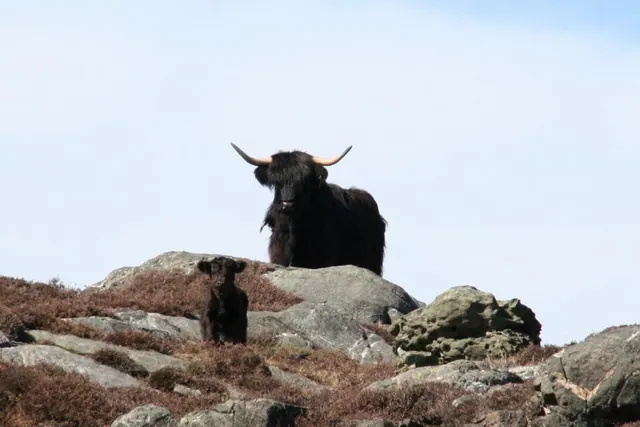
If a caption says ‘miniature,’ ask for the animal’s age and what the owner measured. A tight crop can leave an animal looking small or large depending on the camera angle. Even an object of known size gives you a poor comparison if it’s much closer to the camera than the calf. Ask what the label means to the person using it and whether they can supply a measurement or a record that supports it.
A few questions help here. Who made the claim, and can they show a record? What does the record say, and when? Does the term come from a registry or breed society, or from a seller or a caption writer? If nobody can answer, the label stays a description, and looks like a Highland calf remains a perfectly good thing to write.
Looking again from a distance
Next time someone sends you a Highland calf picture, try writing down three things you can actually see. Where does the hair fall? What color does it look in that light? How much of the head can you see? Then compare your notes with the society’s photographs of adults and calves. A picture cropped tightly around the face may give you one good thing to say. That can be enough.
On a farm visit, look from a place where visitors are allowed to stand. Ask staff where you can watch, and keep the fence or other barrier in place while you take your picture. A zoomed photo can give you the detail you were looking for.
Try the same trick with the caption. Keep the parts you can check, and ask for the record before repeating a claim about ancestry, registration or size.
Related stories


Rosa Benitez
Explains natural history and study methods for nonspecialist readers.