From the archive
Why the Mexican Hairless Dog Can Have a Coat
Prefer Family & Pets on GoogleSee more of our stories in your results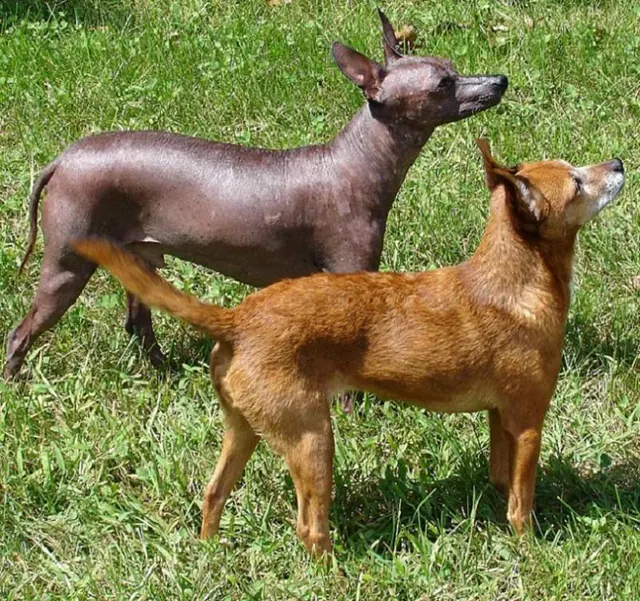
The Mexican hairless dog can have a coat because the breed has two varieties. The American Kennel Club calls the breed Xoloitzcuintli, commonly shortened to Xolo, and recognizes hairless and coated dogs under one official standard. Meet a coated Xolo and you are meeting another variety of that same dog.
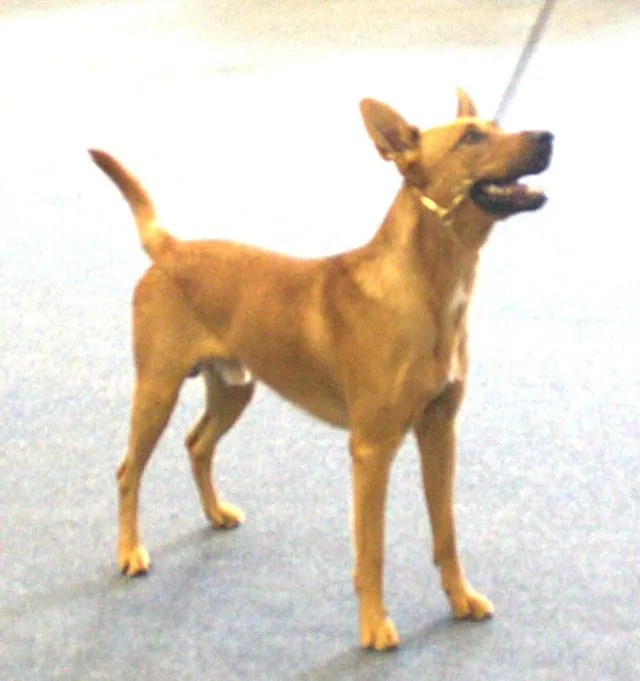
On a coated Xolo, the coat covers the body and lies close. The standard calls for short, smooth hair, so a full coat on this dog can still look sleek. In a side photograph it may be easier to see where the light catches the hairs on the shoulder and flank than to make out each hair. Start by looking at the body as a whole.
On a hairless Xolo, much of the body is bare. Compare two dogs standing side by side, as in the photograph at the top of this page. The difference is easier to see across their backs and sides than at the head. One of the surprises of the standard is that a little hair on a hairless dog's head is allowed.
Two varieties, three sizes
A breed standard is the written description of what a breed is supposed to look like. The AKC standard for the Xoloitzcuintli does two separate jobs. It defines two varieties, hairless and coated, and it defines three sizes: toy, miniature and standard. Variety is about coat. Size is separate. The two are listed as different questions, so a description of a particular Xolo can include both, such as a coated miniature or a hairless toy.
One practical effect is that the word “standard” can confuse people. In this breed it is both the name of the document and one of the three size names. A page that says “standard Xolo” is describing size, not saying the dog is typical or ordinary, and not saying anything about its coat.
You can make a simple table in your head. Put toy, miniature and standard across the top. Then put hairless and coated down the side. The words describe two different features. A large-looking Xolo in a photo can have either coat, and a hairless dog in a close crop could belong to any of the three size groups.
Hairless does not always mean bare
The AKC standard permits a little short, coarse hair on top of the head, on the feet and on the last third of the tail. The hair is optional in those areas. Compare the black dog here with the coated dog above. It is much easier to see the difference by looking across each dog’s body than by looking at the head on its own.
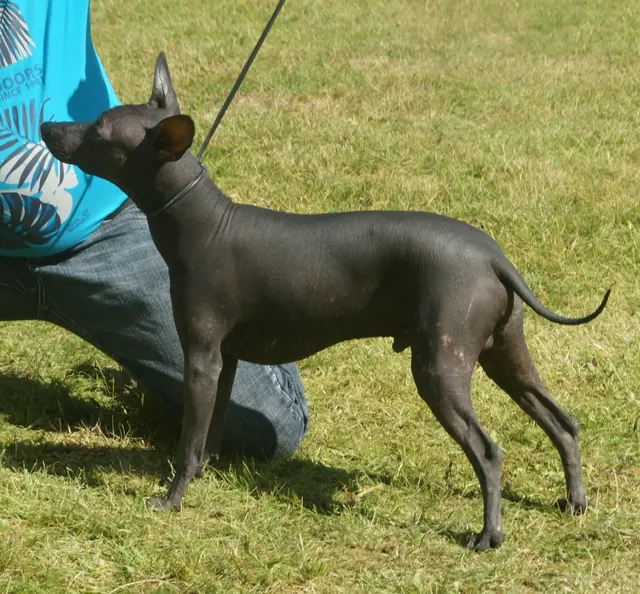
Look at the feet in a clear standing picture, then follow the tail to its tip. A few hairs in those places look very different from the close coat that covers the body of a coated dog. A tight portrait of just the face can make the distinction harder. A full side view is much more useful if you are trying to see the difference for the first time.
Why the two varieties are one breed
The AKC breed guide explains that both varieties belong to the same recognized breed, and that the breed’s parent club chose not to split them into separate breeds. Two things follow from that. First, hairless and coated Xolos are covered by one standard under one breed name. Second, the coat difference works as a distinction inside the breed, in the same way the three sizes do.
Under that arrangement, coated is a variety name in the same way hairless is. Neither is a separate breed name. A caption that says 'coated Xoloitzcuintli' is using two pieces of information together: the coat variety and the breed. You can use 'Mexican hairless dog' as the common name and still call an individual dog a coated Xolo.
Most of the description is shared. The AKC describes a lean, sturdy build, a body a little longer than it is tall, and large ears carried upright when the dog is alert. Those details can make two dogs look more alike than you expected after hearing that one is coated and one is hairless. Compare the outlines in a standing photo before you look for individual hairs.
How to read the three height ranges
The AKC sorts the size groups by height at the withers, the top of the shoulders. Toy runs from 10 through 14 inches. Miniature is over 14 through 18 inches. Standard is over 18 through 23 inches. When you read the numbers, pay attention to the boundary: 14 inches belongs to toy, and 18 belongs to miniature.
Use those numbers when you are comparing two descriptions. A photo taken from floor level can make a toy dog look tall. A standard dog photographed from above can look compact. If you want to know which of the three sizes a description means, ask for the height at the shoulder rather than judging by the angle of a picture.
How to use this when you meet a Xolo
If you are researching the breed, a short routine keeps the vocabulary straight. Read the parts of the AKC standard that cover coat and size first, since they are the source for the terms. Then read the AKC’s breed guide on the two varieties for the explanation of why they are one breed. After that, when you see a dog described online, sort the description into two parts: variety, which is hairless or coated, and size, which is toy, miniature or standard.
If you are talking with a breeder or a seller, the same two-part sort gives you better questions. Ask which variety and which size they are describing for each dog, parents included, and ask to see the dogs or current photos. A seller who uses “hairless” loosely, or uses “standard” to mean ordinary, is not necessarily careless, but you will want the terms pinned down before you compare dogs or prices.
If the description leaves out one of the two labels, that is a good first question to ask. A breeder who tells you a dog is miniature has answered the size question. You still need to ask whether it is hairless or coated. If they tell you the dog is coated, ask what size they are describing and whether the height they give is measured at the shoulder.
A quick way to compare the two varieties
The most useful comparison is between two photographs of dogs standing the same way. Look first at the line of the back and the build. Then check where hair is visible and how much of the body it covers. Once you have seen both varieties in a similar pose, the name Mexican hairless dog is less likely to make you overlook the coated one.
If someone asks whether the Mexican hairless dog they met could really have a coat, the answer is yes. Call it a coated Xolo. Ask a separate question about its size. Those two details will tell the next person more about the dog than the common name does on its own.