
From the archive
Italian Dog Names a Family Can Choose Together
Prefer Family & Pets on GoogleSee more of our stories in your results
Many families assume that an Italian name for a dog is a job for whoever in the house knows the most Italian. That person looks up a word, says it with confidence, and everyone else nods. The assumption deserves a test, because the nodding is where the fun leaks out. A child who only listens has not chosen anything.
So can a child take part without an adult doing the interesting bit? For two parts of the job, yes. A dictionary entry gives a plain meaning that anyone can say back in their own words. Three of the four words below also come with the stress marked, so every family member starts from the same place when saying them aloud. For the third part, hearing how a word really sounds, a child still needs a recording or an Italian speaker. And one job usually stays with an adult: reading an entry written in Italian. The method below keeps that job small and hands the rest to the children.
Four words and what the dictionary says
The activity starts with a small set, because a small set is quicker for a tired adult to prepare. Four words are enough: luna, stella, sole and pepe. Each has an entry in Treccani's online Vocabolario.
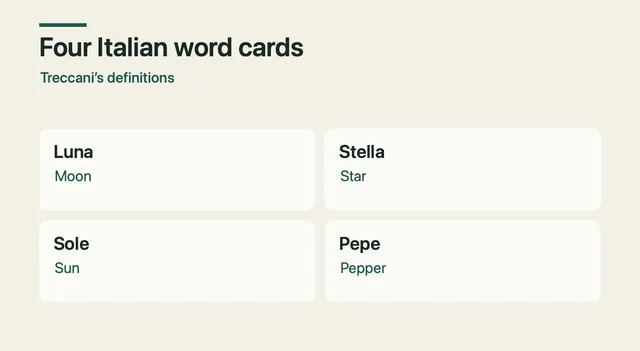
Treccani's entry for luna identifies it as the moon. A child can carry that into the discussion without help: the moon, the one in the night sky. The family can say it in a sentence, which is the test every name on the shortlist has to pass. Where the stress falls in luna is best checked by listening to a recording or asking an Italian speaker.
Treccani's entry for stella identifies it as star and shows the stress on the first syllable. Written as a rough guide, that is STEL-la, with the capital letters marking the louder beat. The guide shows where the stress falls and nothing more, so the vowel and consonant sounds still need a listener.
Treccani's entry for sole gives the Sun, with the stress again on the first syllable, so the rough guide is SO-le. Set beside luna, it gives a child a pair to talk about: the moon and the Sun. Both can be explained in a single short sentence.
Treccani's entry for pepe identifies it as pepper and puts the stress on the first syllable, so the rough guide is PE-pe. A child who explains it as the word for pepper has done the job. The reason the family likes it, if they do, is theirs to add, and it does not need to come from the dictionary.
A short setup, then hand it over
Write each word on its own card or scrap of paper. An adult reads the four entries once and writes the English meaning on the back of each card, along with the stress guide where there is one. That is the whole of the preparation, and it is deliberately the part most children cannot do for themselves. Put a pencil beside the cards and step back.
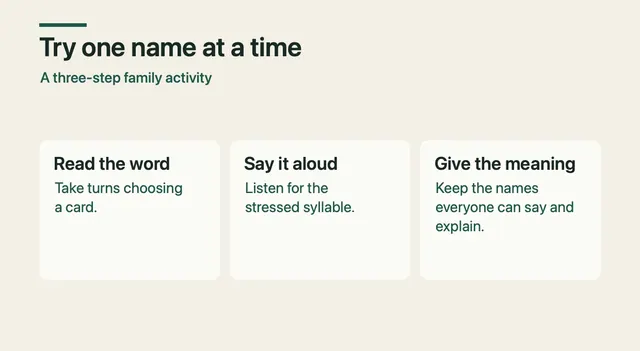
Four jobs cover the four cards, and they rotate so nobody is stuck with the same one. The Reader turns a card over and says the meaning aloud. The Sayer tries the word, following the stress guide. The Explainer puts the meaning into a sentence of their own, such as 'Stella is the word for star.' The Keeper moves each card to the explained pile once its meaning has been said back. A family of six can add a Listener, whose only job is to say what they heard.
Say the word without making a show of it
Start with everyone saying the word together, quietly, at the same moment. A group voice covers any single voice, so a child who is unsure is not on display. After that, anyone who wants to can say it alone. Anyone who passes passes, and the card stays in the pile. Nobody gets a mark for accent.
Stress is the louder beat inside a word. For stella, sole and pepe the entries put it on the first syllable, so a family can clap on that beat while they say STEL-la, SO-le and PE-pe.
A long list of names turns choosing into scrolling. Four cards turn it into a short argument, and a short argument is something a family can finish before the kettle cools.
Build the shortlist
When every card has been read, said and explained, ask three questions about each one. Can I say it? Can I explain it in one sentence? Would I be happy to call it across the garden? Each person answers yes or no with a thumb up or down. A card that gets yes from everyone to all three questions goes on the shortlist. A card with a no is not thrown out. The person who said no explains why, and the family decides whether that changes anything.
The result is a shortlist of names a family can say and explain. It is not a ranking, and it is not a verdict on any dog. Treccani's entries say what these words mean in Italian. They say nothing about how popular any of them is as a pet name. They are a starting set because each one has a meaning a family can check.
Where the method breaks down
The plainest failure is the reading. Treccani's entries are written in Italian, and a child who cannot read them has to wait for an adult to translate, which puts the adult back at the centre. The cards soften that, but they do not remove it. A second failure is social. If one older child takes every role, the others are listening again. Rotate the jobs, and let each person pick which one they want first.
There is a fair objection that four cards and four roles are a lot of setup for a name. The strongest counterexample is a family that already has a favourite. Then the cards add nothing, and the better move is to check the favourite's meaning in a dictionary and say it aloud together once. The method earns its keep only when a family has not yet decided.
A bounded next step
Try it once, on one evening, with four cards and one pencil. Stop when the shortlist reaches two names, and leave the final choice for another day. Skip it if someone finds saying words aloud stressful, if no one can find a recording or an Italian speaker to check the sound, or if the aim is to learn which names are popular.
Mostly, yes. Children can say, explain and choose. An adult still has to read the Italian entry, and someone has to supply the sound. A family that keeps those two jobs small can leave the rest of the evening to the children.