From the archive
Do Dogs Have Belly Buttons?
Prefer Family & Pets on GoogleSee more of our stories in your results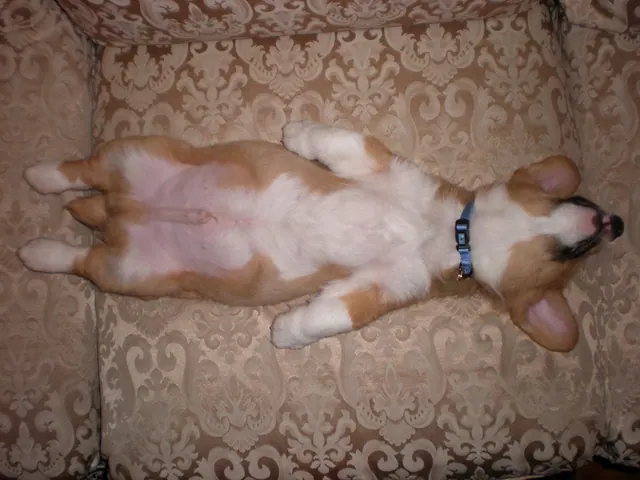
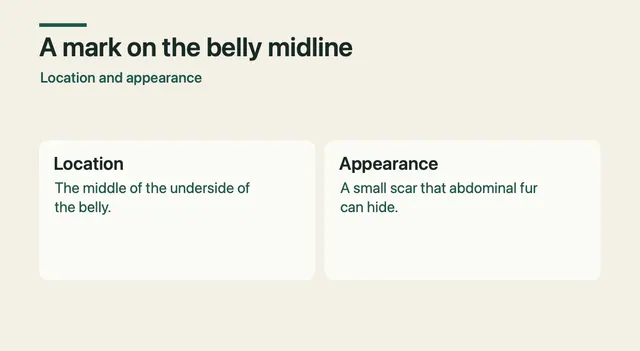
Yes. A dog has a belly button along the middle of its underside. The Animal Medical Center calls it the umbilicus, where the cord's blood vessels attached before birth, and VCA Animal Hospitals says all that's left in most puppies is a faint scar. It is easy to miss. The American Kennel Club describes the scar as small and flat and says abdominal fur can cover it. You can know the belly button is there and still have trouble picking it out in a photograph.
The cord comes first
Before a puppy is born, it develops in the uterus with a connection to the placenta. The umbilical cord is part of that connection. The Animal Medical Center explains that the cord's blood vessels act as a life-support system before birth, providing nutrition and oxygen and removing waste. Those are needs the puppy has before it can breathe air or take milk. The cord has a place at one end where it reaches the puppy's body. That point of attachment is what matters for the belly button.
After birth, the connection is no longer used. The spot on the belly heals, and the mark that is left is the umbilicus. VCA Animal Hospitals calls what's left a faint scar. In this case the word names a normal part of anatomy. A child may think of a scar as the trace of a scraped knee or a cut on a finger. The umbilicus is a different example of how skin can carry a mark after its job changes.
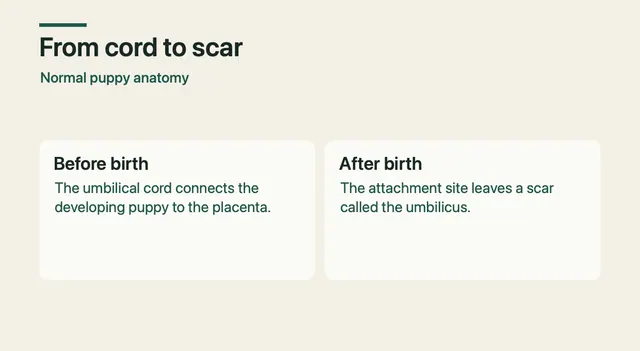
The two terms are easy to mix up. The umbilical cord is the structure that connects a puppy to the placenta before birth. The umbilicus is the place you can name after the cord is gone. Both words belong to the same sequence. One names the connection, and the other names the mark. If the familiar name is easier to remember, belly button and umbilicus both point to the mark on the dog's body.
Where the mark sits
The American Kennel Club says to look along the centerline of the abdomen. The midline is an imaginary line down the center of the underside, with the dog's left side on one side and the right side on the other. It is useful in an anatomy drawing because the artist can leave out most of the coat and show you how a point relates to the ribs and belly. On a real dog those landmarks are part of a three-dimensional body.
The American Kennel Club places the mark below the rib cage, along that central line. Think of the rib cage as one landmark and the midline as the other. Together they describe a location even when the scar blends into the rest of the skin. Anatomical names often work this way. A named part can have a predictable place while its shape, texture or outline varies enough that it takes a moment to recognize in an unfamiliar photograph.
Why fur makes a difference
The American Kennel Club says a dog’s belly button can be smaller and flatter than the one a person is used to seeing on their own body. A flat scar gives the eye little shadow to follow. Think about what makes a small mark obvious in a picture: a strong outline, a change in color or an edge that interrupts a pattern. Some belly buttons are easy to recognize from across a room. A dog's can be the kind of detail that disappears at that distance.
Abdominal fur can also cover the skin around it. The American Kennel Club points out that you may see a little swirl of fur over the area. A swirl is a pattern made by the hair, and the umbilicus is the mark on the skin below. The two may occupy roughly the same spot. A photograph that shows a belly clearly can still show the coat more clearly than it shows the skin.
Look at the sleeping corgi in the photograph. Its belly is on view, and your eye still goes first to the bigger shapes around it. The legs and edges of the coat are easier to make out than a small mark on the skin. The photograph gives a sense of why a child might ask the question in the first place. We can see the underside of the puppy well enough to recognize it, even if the individual scar has no clear outline in the picture.
The same name on different bodies
A person has a belly button for the same broad reason a dog does. The cord had an attachment before birth, and its former attachment is visible later as the navel. The resemblance makes sense once you picture the connection. The differences in appearance are easier to understand once you picture the skin and coat. The familiar bump or dip on a person gives a child one picture of a belly button. A little flat scar gives them another.
The Animal Medical Center applies the same word to cats. The word can be used across species because it describes the kind of structure and where it comes from. There is room for differences in appearance without changing what the term means. That is useful when a child points to an animal and wants to know whether a word they know for their own body fits. A shared name can lead to a shared explanation, even when the picture is different.
What you can tell at a glance
There are two observations to keep apart. You can identify the general part of the belly in a picture from its midline and ribs. Whether you can make out the scar in that picture depends on what the photograph shows. Fur, the angle and the size of the image all affect the details you can see. A missing outline in a photo is a perfectly ordinary outcome when the part in question is flat and partly covered.
The next time the question comes up, start with the cord. A puppy had that connection before it was born. The spot where the cord joined the body became a scar on the belly midline. A person might recognize the idea from their own navel, then discover how different it can look on a dog. Belly button is an everyday name for a small detail that goes right back to how the puppy grew.