From the archive
How Smudge the Cat and a Real Housewife Became One Meme
Prefer Family & Pets on GoogleSee more of our stories in your results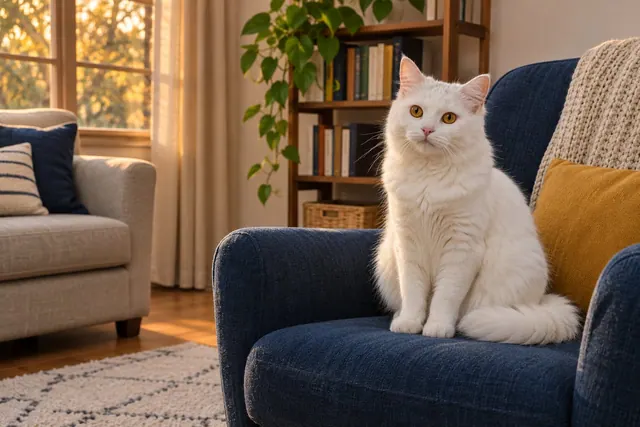
Who was talking to whom in the image known online as woman yelling at cat? Nobody was, at least not to each other. It pairs a moment from a television show with a photo from Tumblr. Bravo's recap names the woman as Taylor Armstrong and places the original scene in Season 2 of The Real Housewives of Beverly Hills, with Kyle Richards next to Armstrong. Bravo credits the white cat photo to a Tumblr post and the pairing to a user on X.
If you know only the nickname, the titles give you a place to start looking. One half has a season of a television show behind it. The other has a cat’s name and an owner who has described how the photo was taken and posted.
The television half: a Season 2 scene
Bravo places the scene at Brandi Glanville’s Malibu Beach party during Season 2. Taylor Armstrong was speaking in a group that included Camille Grammer and Dede. In the first panel of the meme, Bravo identifies Kyle Richards beside Armstrong, comforting her. A moment that began at a party became one freeze-frame, with the people it showed still recognizable and the rest of their conversation left out.
Armstrong acknowledged the image online. Bravo reports that she shared an article about the meme, identified herself as the woman in it and sent the joke to Grammer. The network dates the original scene to 2011. A person who knew the television series could put Armstrong’s name to the picture. Anyone who had only seen the meme could still recognize the expression.
Smudge’s photo at the dinner table
Bravo credits the white cat photo to Tumblr. Smudge’s owner described the history of that photo in a Know Your Meme interview and talked about how it came to be posted. The cat has a name of his own, even though the image usually circulates under a label about what appears to be happening between the two figures. His owner had been working at a cat rescue when she answered an ad for a kitten, she recalled. She found an adult cat and initially meant to find him another home. By the end of the ride home she had decided to keep him. The cat at the table was the one she brought home that day.
Smudge’s owner gave a more ordinary account of what was happening at her dinner table. The family often left a chair open for him. They had finished eating when he jumped into a seat someone had used. She was scratching his head when he made the expression that led them to take pictures.
The owner told Know Your Meme she posted the image to Tumblr because it made her laugh. She wrote a caption in the style of earlier cat memes. She had mostly been posting for herself and had few followers besides friends and family. She later noticed that people were sharing the photo on Tumblr, before the pairing with Armstrong came along.
A cat photo can stand on its own in a way a single frame of a conversation rarely does. You can look at the cat without having to ask what someone just said. Put another picture beside it and you may find yourself supplying exactly that question.
Two separate posts, one pairing
Bravo credits the person who put the pictures side by side on Twitter, now X. Read the expressions together and Armstrong can look like a speaker waiting for a reply, while Smudge starts to look like the one answering. The viewer can imagine a line for the first panel and another line for the cat.
The pairing made it back to television in 2023. When Armstrong visited Watch What Happens Live with Andy Cohen in June, Bravo says she brought a stuffed white cat. The toy stood in for the animal in the image. A photo on a screen would also have made the point, but the white cat was enough to call the picture to mind.
In a two-panel picture, look for the seam. One panel may have different framing or lighting, or simply show a different distance from its subject. Those little breaks can tell you that you’re looking at separate pictures even when the pair seems to suggest a conversation.
Why two panels read as a conversation
One way to read a split frame is like a cut between two people in a filmed conversation. Imagine putting a picture of a person with a raised hand next to a picture of a tilted head. The placement can invite you to supply words for the first person and a response for the second.
Try it with two made-up captions. In one, the person asks who took the last cookie and the cat insists there were never any cookies. In another, the first panel asks which film to see and the cat has already picked one. The same glance can be a denial in one version and a decision in the other.
Where the reaction reading breaks down
A viewer can mistake the pairing for a single moment. Bravo puts the television scene in Season 2 and credits the cat photo to Tumblr. The two pictures would have different histories even if nobody had put them side by side. The conversation comes from the way they were joined.
A fair objection is that none of this matters for a joke. Nobody needs a source trail to enjoy a cat photo, and tracing every meme would flatten what makes it funny. That is true for casual sharing. The trail matters in narrower cases: when a photo is reused elsewhere, or when a reader wants to know who deserves credit. In those cases the difference between a recap, an owner's account and a pairing credited to a user is practical.
Reuse is one such case. The owner's interview describes the photo. It does not grant anyone permission to republish it, and a recap of a television scene does not grant that for the still either.
A way to look again
A short way to look again: when a two-panel image appears, ask what each panel came from, who is credited with putting them together, and whether the layout or the caption is doing the talking. The habit has a limit. It traces origins and pairings, and it cannot say why anyone in either picture did what they did.