
From the archive
Why the Sheepshead Fish Has Teeth That Look Like Ours
Prefer Family & Pets on GoogleSee more of our stories in your results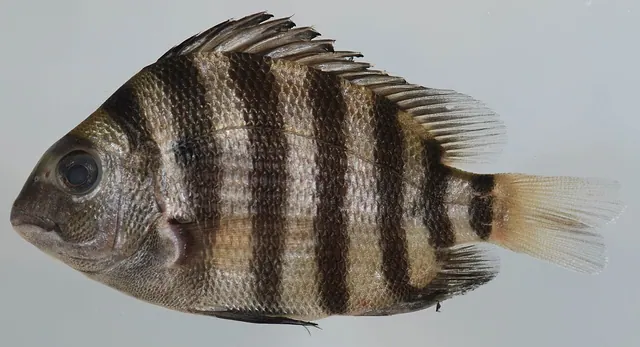
You can recognize what’s strange about a sheepshead before you know its name. The fish has a silver body marked with dark bars, much as you might expect from something you’d see off a pier. Then there’s the mouth. The row at the front looks enough like a row of human teeth to get a second look. The Florida Museum calls those teeth incisor-like. There are other shapes behind them, including rows of molars.
Once you know where to look, the familiar smile is only the beginning. Sheepshead eat animals with hard shells. The fish can crush or grind what it picks up, and it scrapes barnacles from hard surfaces. Those jobs help explain why biologists describing the mouth spend time on the heavy teeth you’re less likely to see in a photograph.
The teeth you see first
An incisor is a front tooth. Run your tongue behind your own front teeth and you can feel the edge that meets the food first. In the sheepshead photo, look for the relatively flat surfaces lined up at the front of the jaw. You can see why someone would reach for a word they learned at the dentist. The fish has a different set of teeth behind its front row, and that part of the mouth also gets a familiar name.
The Florida Museum describes three rows of molars in the upper jaw and two in the lower jaw. Think about that on your next look at a photo of the fish. The face can fill the frame while the layout of the mouth stays almost entirely hidden. A picture taken straight on can show the first row beautifully. To see why the rest is interesting, it helps to look at the fish from the side, then look for a view down into the mouth.
You can make a rough picture of the arrangement without drawing a single convincing tooth. On a piece of paper, put a short row of marks at the opening of the mouth. Behind that, sketch parallel rows of small rounded shapes. You now have two places to look when you go back to an identified image. The marks at the front are the ones the smile usually puts on display. The shapes farther back make up much of the equipment for a hard meal.
‘Human-looking’ is a description of the resemblance people notice. Incisor and molar describe teeth by features and position. In this fish the combination is useful because one mouth meets food in different ways. The museum describes both collecting prey from a hard surface and breaking it down once it is in reach. It takes more than a good grin to do that.
A meal that puts the back teeth to work
A barnacle on a piling is easy to overlook from above the water. For a sheepshead it’s a possible meal. The Florida Museum describes fish scraping barnacles off rocks and pilings and crushing heavily armored or shelled prey. A close look at that diet makes the mouth seem a little less improbable. A shell protects the animal inside it. A tooth that can get purchase on the prey and strong teeth that can break the shell are useful tools.
The meal changes as the fish grows. The museum lists tiny drifting animals and small larvae among the foods young sheepshead eat. That could be a surprise if the only sheepshead you’ve seen is a big one with its mouth open. A photograph of an adult captures a mouth at one point in its life. The animal did plenty of eating before it grew into that face.
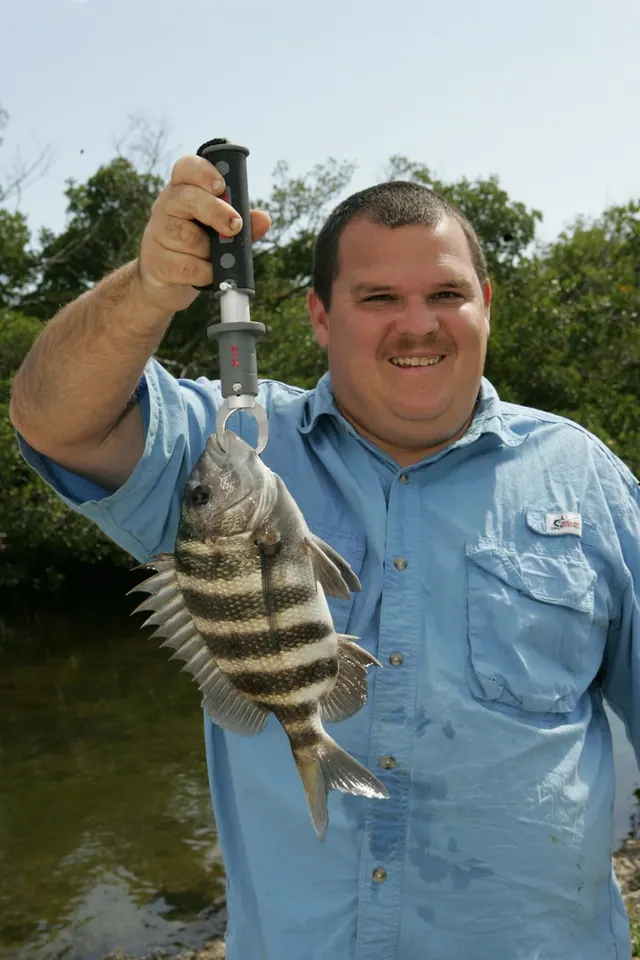
Sheepshead are often found around inshore structures such as pilings and jetties, or in brackish habitats, where fresh water mixes with salt water. Those places give you a useful setting for imagining how it feeds. The barnacles can be right on the structure beside it. The fish’s most recognizable feature makes more sense when you picture that scene instead of a mouth shown on its own.
What researchers found inside a tooth
Jeremiah Deang and colleagues asked a smaller question in a 2018 study. They examined the materials in sheepshead teeth. One layer, called enameloid, is near the outside of the tooth. Another material, dentin, lies deeper in. The team used a tiny instrument to press into polished samples and measure how the materials responded. They also looked at the shape of the tissue under a microscope.
The outer material was harder than the dentin in those measurements, and the researchers found that hardness increased toward the surface. Imagine trying to answer that question by looking at an ordinary photo of the fish. You might notice how white a tooth is, or how thick it looks. The differences the team reported came from measuring parts of a tooth you can’t see in a smile. The experiment measured the material, so it gives no reading of the force a whole fish can put into a bite.
That distinction is handy the next time someone describes an animal as having an amazing bite. The shape of a tooth, the hardness of its outer layer and the force delivered when two jaws close are different measurements. The sheepshead has enough going on in its mouth that the narrower question is interesting in its own right.
Look beyond the smile
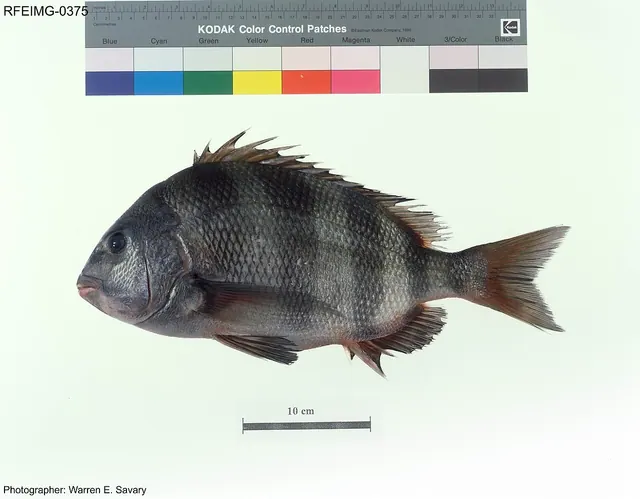
For a photo labeled sheepshead, try starting with the whole animal. Look for the dark bars across the sides, the deep body and the small mouth. The Florida Museum notes that the bars tend to be most distinct in young fish. Check where the fish was found and who identified it. The scientific name, Archosargus probatocephalus, helps when a picture has traveled from its original caption to a repost.
Then go back to the face. If the front teeth are all the photo gives you, you can still compare their shape with an identified sheepshead. You’ll want more than a similar-looking smile to decide what an unfamiliar fish is. Even with a confirmed sheepshead, there’s a better question than how much its teeth look like yours. Which teeth can you see, which ones are hidden, and what might that mouth be eating where the fish lives?
Related stories



Rosa Benitez
Explains natural history and study methods for nonspecialist readers.