From the archive
The First Year of a Cheetah and a Labrador at Busch Gardens
At their first public appearance at Busch Gardens Tampa Bay in 2011, Kasi was an eight-week-old cheetah cub and Mtani was a 16-week-old Labrador puppy. A contemporary anniversary report from Attractions Magazine describes their early supervised play and says that by the 2012 anniversary they shared the park’s Cheetah Run habitat. Their time together after that first year is uncertain.
The park’s first-year video lets a family see the two young animals together. If you are watching with children, give the youngest person the first choice of which animal to follow. The rest of you can watch the same clip and notice something different.
Watch, notice, compare and ask
Have a pencil and a piece of paper ready if someone wants to draw. Let the child pick Kasi or Mtani. Watch once, pause at the end and give the child time to tell or draw one thing they noticed. Compare that observation with one from someone else. If there is time for a second viewing, choose a different question before you start it. The only preparation is finding the video and making enough room for everyone to see it.
If a younger child cannot choose, pick the first animal together and watch without pausing. If an older child wants a challenge, have them ask the group a question and see how many answers people give. A child who just wants to watch can skip the paper and the questions. Let the child who is interested do the noticing; an adult’s useful job is starting or pausing the video. Give the conversation a few minutes and stop when everyone has shared one observation.
What the pair did in their first year
At the first anniversary, Attractions Magazine reported that the pair spent part of the day playing, exercising and training with keepers. The two also made visits to schools and events as animal ambassadors.
Busch Gardens says Kasi and Mtani exercised with the habitat’s lure system.
In November 2011, Kasi and Mtani accompanied their keepers to school visits for the Great American Teach-In. The park’s account, published by Behind The Thrills, names four stops: Heritage Elementary in New Tampa, Wilson Middle in South Tampa, Quail Hollow Elementary in Wesley Chapel and Schwarzkopf Elementary in Lutz. The keepers used the visits to talk about cheetah conservation. For students who met them there, the pair was part of a lesson rather than a visit to an exhibit.
Put the events in order and the year has three distinct moments. The public saw a cub and a puppy together in 2011. The pair joined zoo staff at schools that November. At the anniversary the park and the contemporary report described the two sharing Cheetah Run. If one detail sticks with a child, ask where it belongs. A school visit belongs between the two dates, while training and exercise at the shared habitat belong to the account of the anniversary. That is a manageable amount of history for a short video to open up.
A separate account of zoo staff at work
Busch Gardens trainers Justin Garner and Antonio Ramirez describe a hand-reared cheetah and a shelter dog as one group in a staffed animal management program in the 2014 proceedings of the Animal Behavior Management Alliance. They do not identify the pair as Kasi and Mtani. Their account shows how a zoo team organized its work with a cheetah and a dog. It describes a zoo arrangement, not a model for a household.
When a child asks what an animal care team does, one way to answer is to ask which job they noticed. A person can work at a zoo and spend part of a day looking after animals, part helping them take part in an activity and part speaking to people. The supervised play, exercise and classroom appearances from Kasi and Mtani’s first year give families one example of each kind of work.
The park’s current cheetah page covers Cheetah Run and describes a track for running demonstrations. It also links to Cheetah Hunt, the park ride with a similar name. If you want to look up the place named in the anniversary video, start with the animal habitat. The track is an example of a feature you can look for when you compare a zoo habitat with a photograph of an animal running.
The enclosure above and the runner below
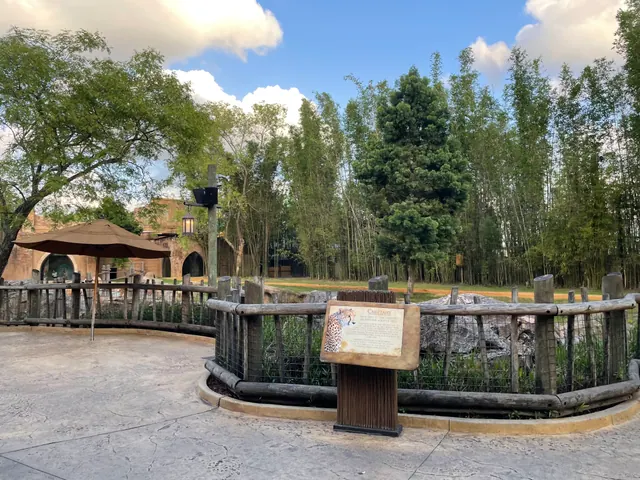
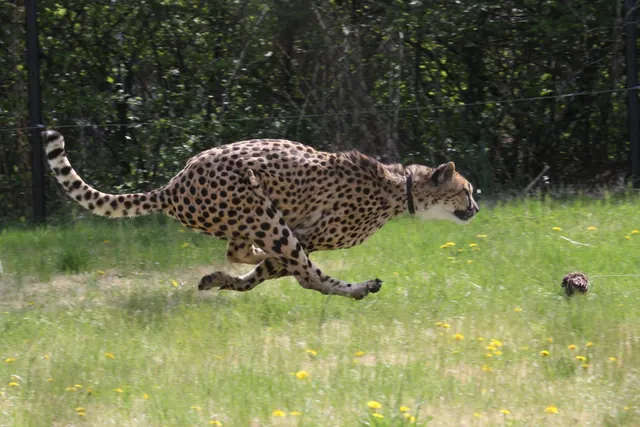
The empty enclosure above is a photograph by Adog of Busch Gardens’ Cheetah Run as it looked in 2022. The photograph below shows a different cheetah running at the Cincinnati Zoo. In the Cincinnati image, look at the animal’s stretched body and the position of its legs. Try pointing to all four feet before you move on to the video. The Smithsonian’s National Zoo explains why cheetahs can reach so far in one stride: a flexible spine helps lengthen their stride. It also describes the tail as a counterbalance during quick turns. A child who wants a closer look can trace the line of the tail in the still photo, then return to the video and see what they notice about the way each animal moves. Use the still photograph to look closely at one body and the video to watch the pair. The Smithsonian also describes paw pads and partly retractable claws that help the animal grip the ground. Look first at the line of the back in the photo, then ask where the feet are in relation to the body.
One question to take to a zoo
End with one question for a keeper. You could ask what the first play sessions were like, what the animals did when the lure moved or what the students wanted to know about cheetahs. Let the child choose a question that follows from something they noticed. If you visit a zoo another day, you can take the question with you and ask what kinds of activities its keepers use with the animals there.
There is no need to get every question answered in one sitting. If the first thing your child wants to know is which animal was older, you have the ages. If they ask what the pair did away from the habitat, the school visits are a place to begin. A good first look can end as soon as everybody has one detail they remember and one question they would like to ask.